Kirkwall Airport CHP
Project:
Kirkwall Airport CHP (Combined Heat and Power) Unit
Timescale:
2021 – 2025
Funder:
The Scottish Government via Highlands and Islands Enterprise, supported by work on the SATE and Rural Energy Hubs projects
Project overview:
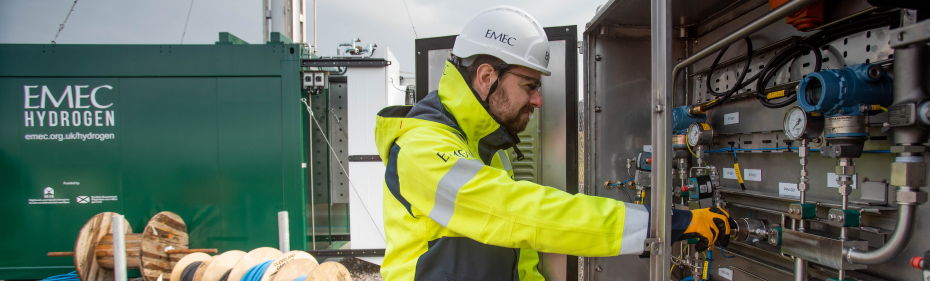
This project involved installing and demonstrating a novel hydrogen combustion engine at Kirkwall Airport in Orkney.
Though a small island airport, like most airport buildings, Kirkwall has large open spaces and doors that are frequently opened for passengers, which makes it a challenging environment to keep warm.
Kirkwall Airport’s heating demand is intermittent with oil-fired boilers operating when the airport is open, starting up in the morning and shutting down late in the evening after the arrival of the last flight. During the day, the boilers cycle on and off numerous times to maintain comfortable temperatures in the terminal.
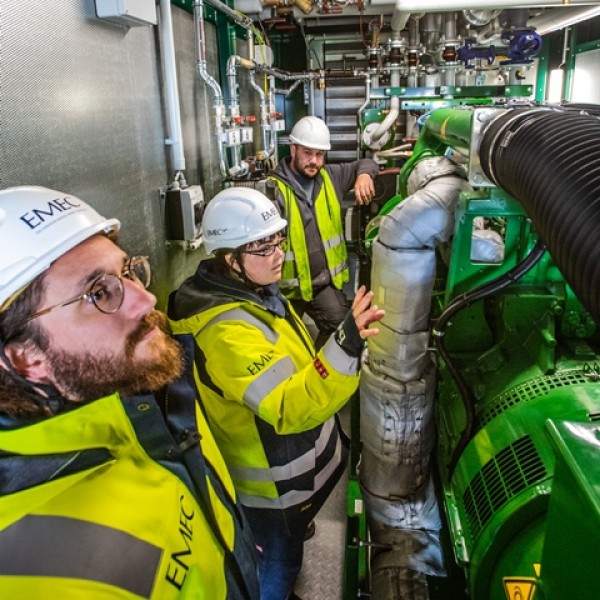
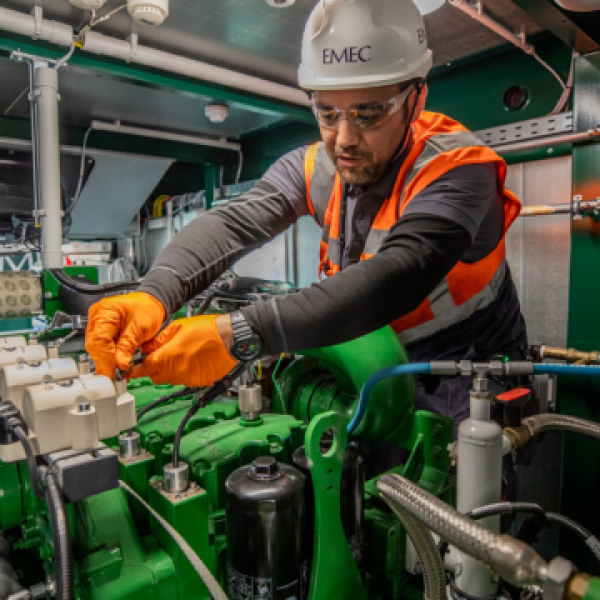
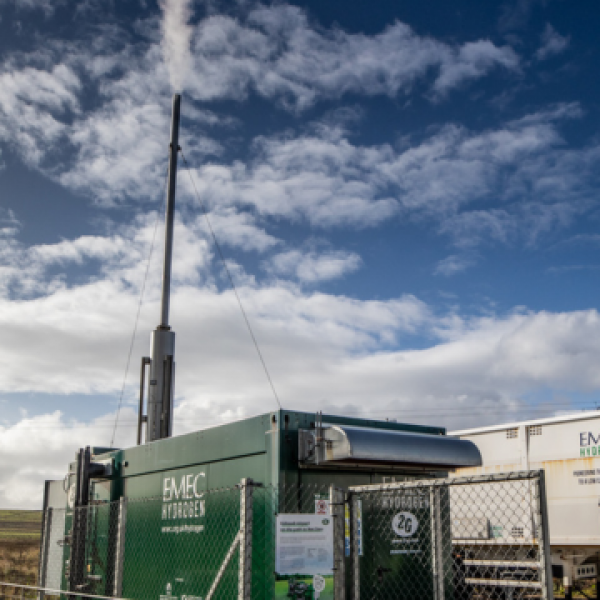
The hydrogen-ready combined heat and power (CHP) unit, manufactured by 2G and supplied by their then UK technology partner Doosan Babcock, was deployed as part of of the hydrogen powered energy system to be trialled.
The original aim was to integrate the CHP system with the airport’s existing heating network to to demonstrate the concept of meeting the heat and power needs of the main terminal buildings using hydrogen as a power source. During the trial, the plant operated on green hydrogen supplied by EMEC, generating electricity while recovering and utilising by-product heat. The CHP’s waste heat would supplement the oil-fired boilers, reducing their runtime and oil consumption.
In order to run this demonstration, several modifications were required to integrate the hydrogen plant with the airport’s existing systems:
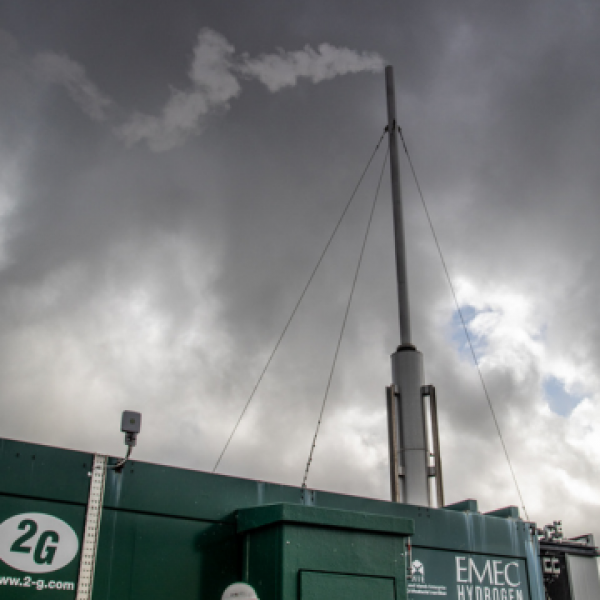
- Civil works: Construction of a fenced compound and laydown area airside to house the CHP plant equipment.
- Installation of flow and return pipework to connect the hydrogen system to the existing heating network, along with a gas control unit in the compound to enable the supply of hydrogen from the tube trailer to the CHP plant.
- Electrical works: New cables and protection devices were installed to connect the CHP into the existing electrical infrastructure at the airport, as well as installation of equipment to set up a new Active Network Management (ANM) connection with SSE.
During commissioning and SAT testing, it was possible to demonstrate separate parts of the unit. This culminated with the fully-integrated trial during the first week of October 2025, marking a UK first: hydrogen was successfully used to meet both power and heat demands at a commercial airport.
Background:
This initiative formed part of a broader programme led by EMEC and HIAL to decarbonise airport operations. Opportunities for reducing emissions were identified through an energy consumption study delivered by EMEC under the ReFLEX Orkney project, which revealed that space and water heating in the terminal accounted for the largest source of greenhouse gas emissions after aircraft operations.
Partners:
- EMEC
- 2G
- Highlands and Islands Airports Limited (HIAL)
EMEC’s role:
EMEC lead the project, procuring and managing suppliers as the principal contractor to install and commission the hydrogen ready combined heat and power engine airside at Kirkwall airport. This included equipment, civils and integration of the CHP with existing airport infrastructure. EMEC also produced and supplied the hydrogen for the demonstration from its production plant on Eday. EMEC oversaw the demonstration in collaboration with HIAL and 2G, applying safety and risk management approaches to the demonstration in collaboration with Abbott Risk Consulting (ARC).
Outcomes:
The completion of this trial helps to assess the real-world feasibility of integrating hydrogen technologies with airport infrastructure. The insights gained will contribute to wider efforts exploring low-carbon solutions across aviation and other sectors.
Through completing the trial, it demonstrated that hydrogen-powered CHP systems can work for small, remote industrial or commercial sites, provided that there is a reliable local supply of hydrogen and that careful planning and risk management are in place.
Installation & integration
- A hydrogen-ready CHP unit was installed airside at Kirkwall Airport and integrated with the existing heating system to deliver heat to the main terminal and power across the site.
- Collaboration: Early engagement with stakeholders (airport operators, insurers, regulators) is vital to streamline approvals and ensure compliance.
Performance during trail
- The fully integrated technology demonstration was able to take place in October 2025.
- During the trial, additional electrical loads were introduced to test performance, enabling the CHP to maintain a steady output at around 60% capacity.
- The system met 100% of the airport’s electrical and heating demand during the demonstration.
- Electricity for the terminal and runway lighting
- Heating demand met without relying on the airport’s boilers.
Safety and Risk Management:
- Undertaking technology demonstrations airside adds more complexity to a pilot project in terms of access and insurance. These considerations should be factored into project planning.
- Comprehensive HAZID/HAZOP studies are essential to identify and mitigate risks, including worst-case scenarios like hydrogen loss of containment.
- Zoning and understanding spark potentials are critical for safe integration.
Project news:
- October 2025: Hydrogen used to power Kirkwall Airport in UK-first demonstration
- January 2021: Green hydrogen to decarbonise Kirkwall Airport