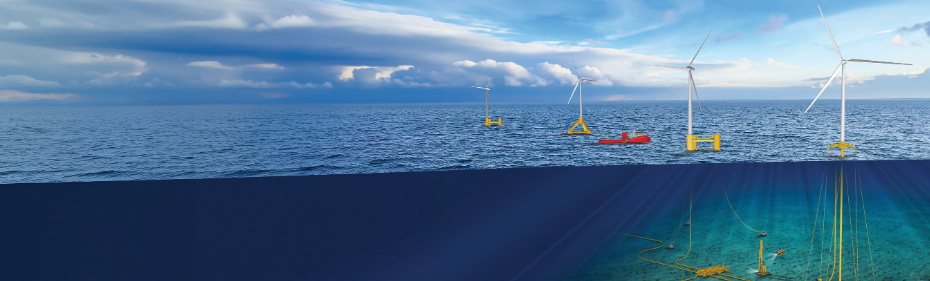
Deepwater wind test site
The challenge
The UK stands at the cusp of a transformative era for the offshore wind industry, having set highly ambitious goals for offshore wind deployment with a pipeline of >48 GW of floating projects already announced. However, the current operational offshore wind capacity in the UK is around 16 GW (as at 2025), almost all of which has fixed bottom foundations. None of the floating and other deepwater wind technologies being proposed have been deployed and proven at the scales required.
The UK is fortunate to benefit from consistent high wind speeds due to its geographical position at the end of a long fetch over the North Atlantic. Whilst this creates consistent strong winds for power generation all around the country, the energetic wave and wind conditions are a challenging environment for floating structures to operate in.
As UK offshore wind projects scale into deeper waters, developers require a representative environment to prove, refine and de‑risk technologies before full commercial deployment. However existing test sites across Europe lack the necessary metocean conditions for the offshore wind projects in the UK’s pipeline. See EMEC white paper (2023) for further analysis and needs case for a national floating and deepwater wind test site.
Such technologies typically require to demonstrate a minimum of 8,000 hours of normal operations in a representative environment (i.e. at full scale and in real world conditions) to satisfy certification bodies and avoid expensive and limiting insurance. Insurance and certification are both vital to ensuring final investment in a project.
DeepWind – EMEC’s proposed deepwater wind test site
EMEC’s aim is to establish a national test site for the UK to support the next generation of floating and deepwater offshore wind technologies. Following an extensive review of potential locations across the country, the objective is to secure a site in water depths of 60-100 m, with metocean conditions representative of future commercial developments. Multiple site options are currently being explored. The location, layout and configuration of the DeepWind test site are being shaped through extensive engagement with developers and the wider offshore wind sector, informed by work undertaken by EMEC since 2020.
The site will enable developers to de-risk technologies, putting turbines, floating structures, moorings and other components to the test in an energetic offshore environment. This will enable performance to be refined on a wide range of technologies prior to commercial scale-up and build-out.
The plan is to develop the test site in two phases, each providing space for four berths capable of hosting wind turbines up to a maximum of 20-25 MW rated power (350 m tip height). The first phase will have a grid connection capacity of 60 MW. The second phase would be developed as and when the demand for it has been demonstrated with phase 1.
Building on 20 years of experience operating offshore test sites, helping to reduce the time, cost and risk of demonstrating technologies in the sea, EMEC will provide site management, technical and supply chain link-up support to allow developers to focus intently on developing and demonstrating their technologies.
Potential economic impact
Independent analysis by BiGGAR Economics calculates that the proposed demonstration site has the potential to generate £690 million gross value add (GVA) to the UK economy, £442 million of which will accrue in Scotland. BiGGAR’s economic impact analysis considers the full value chain, from construction and development of the site through to operation and client demonstration activities.
The study anticipates the facility will create 4,160 new jobs in the UK, 2,220 of which will be in Scotland, during its expected 25-year lifetime.
DeepWind brochure

Contact
If you’d like to discuss this project with a member of the team, please contact: commercial@emec.org.uk
News
- October 2026: |£3M to advance EMEC DeepWind test and demonstration site
- January 2026 | Next phase of UK deepwater wind test site development begins
- December 2023 | White paper details needs case for UK National Floating Wind Test Centre
- January 2023 | EMEC floating wind demo site offers £690 million opportunity to UK
- October 2022 | EMEC concludes concept design on 100 MW floating wind test site