Sustainable Aviation Test Environment (SATE)
SATE: Regional Sustainable Aviation Strategy
Quick facts:
Funder: Innovate UK and Department for Transport via the UK Government’s Future Flight Regional Demonstrator Competition
Funding: £199,912
Partners: Highlands and Islands Transport Partnership (HITRANS) – lead partner, Hybrid Air Vehicles, Skyports Deliveries, Streamline Shipping Agencies, EMEC, University of the Highlands and Islands (UHI), NHS Grampian, Urban Foresight, Windracers, Regional & Business Airports Group, Loganair, Shetland Islands Council, Cormorant SEAplanes, Cranfield Aerospace Solutions
Project website: sate.scot
Project overview:
Following SATE 2, the project has been awarded follow on funding to deliver a regional sustainable aviation strategy. The strategy will create a roadmap for new aviation technologies including regional drone operations, electric take-off and landing (eVTOL) or zero emission conventional take-off and landing (CTOL) aircraft. This will outline how they could eventually support lifeline services, contribute to net zero ambitions and bring economic development to the Highlands and Islands. Future uses of drone and low-carbon aircraft being explored include rapid delivery of medicines, such as chemotherapy drugs, significantly helping patients and cutting waste, improved logistics for high-value, time-sensitive industries such as seafood and aquaculture, and faster access to renewable energy infrastructure.
In-depth case studies will be undertaken across the region, focused on Orkney and Argyll & Bute, to inform the overall strategy. Findings will also help develop aviation projects for other remote and rural regions where aviation is essential.
EMEC’s role:
EMEC will lead a dedicated study into existing aviation infrastructure in Orkney. This will assess how current assets and operational capabilities can support the transition to low-carbon aviation.
EMEC’s work will include:
- Mapping infrastructure
- Identifying gaps and opportunities for sustainable aviation integration
- Feeding findings into the broader project roadmap
News:
October 2025: SATE awarded funding to chart the future of sustainable aviation in the Highlands and Islands
SATE 2
Quick facts:
Project: SATE 2
Duration: 2022 – 2025
Funding: £8.9 million
Funder: UK Research and Innovation (UKRI) through the Future Flight Challenge
Partners:
- Lead partner: At the start of the project Highlands and Islands Airports Limited (HIAL) was the lead partner but during the project this was transferred to Highlands and Islands Transport Partnership (HITRANS)
- Consortium partners: HIAL, Arcadis Consulting Limited, Connected Places Catapult, Cranfield Aerospace Solutions, EMEC, Flare Bright Ltd, HITRANS, Loganair, University of Highlands and Islands (UHI), Windracers Limited, Highlands & Islands Enterprise (HIE), Orkney Islands Council, Hybrid Air Vehicles, Loganair, Cormorant Seaplanes, ARC Aerosystems
Project overview:
EMEC’S role
Project outcomes:
Flight Trials:
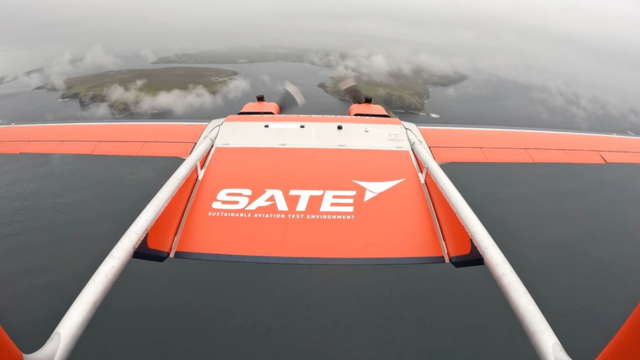
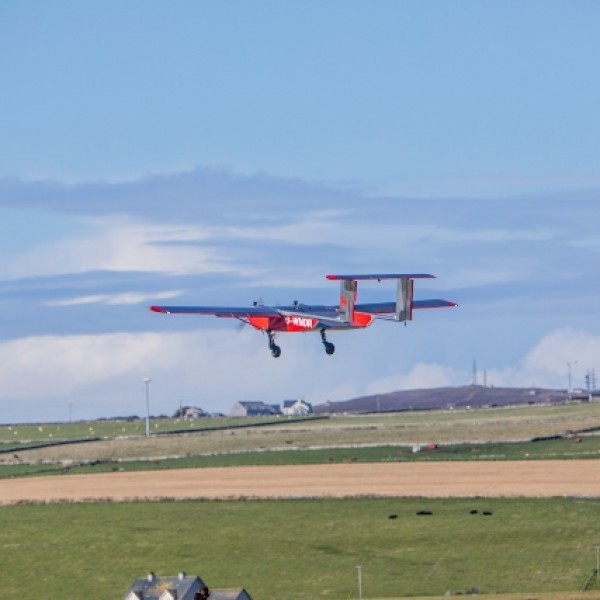
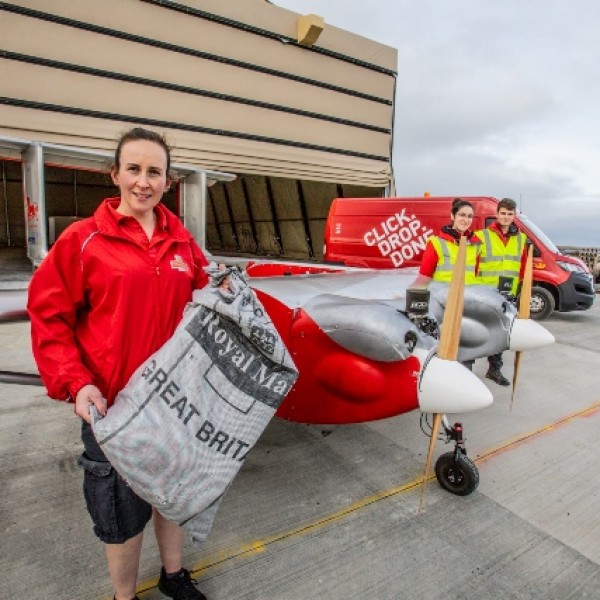
- August 2024: Windracers operated its ULTRA autonomous cargo aircraft on scheduled routes between Eday, Westray, and North Ronaldsay over nine weeks, supported by Streamline Shipping Group using electric vans for last-mile logistics.
- October 2023: ARC Aerosystems completed tethered trials of its VTOL aircraft at Wick Airport
Feasibility Studies:
- Hybrid Air Vehicles assessed the suitability of Airlander for regional transport, and Cormorant explored seaplane operations.
Environmental Impact:
- A seabird survey during Windracers’ trials confirmed no disturbance to local colonies, supporting safe integration of autonomous aircraft.
Regulatory Engagement:
- Participation in two CAA sandboxes strengthened collaboration and informed future regulatory frameworks.
Hydrogen refuelling in airport environments report: Led by EMEC with HIAL and Cranfield Aerospace Solutions, this report provided the first comprehensive assessment of how hydrogen can be safely and practically introduced as an aviation fuel at operational airports, covering infrastructure, protocols, safety, and compliance.
While some planned demonstrations were delayed due to regulatory complexities and partner changes, significant progress was made toward establishing a dedicated airspace test environment. A WP5 study explored the feasibility of the Trial Orkney Test Zone (TOTZ) based at Kirkwall Airport, laying the groundwork for future sustainable aviation operations which will be progressed under follow-on funding.
Lessons and impact:
EMEC in collaboration with HIAL, Cranfield Aerospace Solutions, delivered the first in-depth assessment of hydrogen refuelling in a commercial airport setting. The report investigated how hydrogen can be safely and practically introduced as an aviation fuel at operational airports, focusing on infrastructure, operational protocols, safety, and regulatory compliance. The report found that in the short term, procedural changes are required, such as adopting aircraft-to-refueller approaches and identified that solid-stage hydrogen storage as a promising long term solution. The study also stressed that hydrogen purity is critical for aviation, and that further investigation is needed to understand the cost implications of achieving and maintaining purity standards across different production pathways.. The outputs and recommendations provide a pathway for future work and aimed to inform future Civil Aviation Authority (CAA) guidance for hydrogen refuelling.
News:
July 18: Funding boost for sustainable aviation testing in Orkney
Oct 2024: Scottish Sea bird colonies unaffected by Windracers ULTRA flights
SATE 1
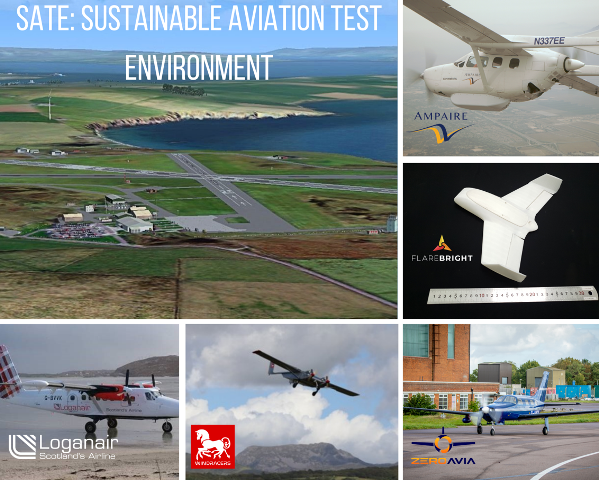
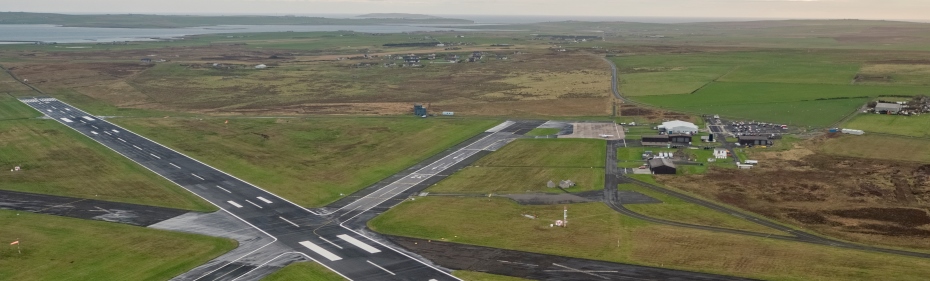
Kirkwall Airport set to be the location for a Sustainable Aviation Test Environment (Courtesy of SATE)
Project overview:
The SATE project project will create the UK’s first operationally-based, low-carbon aviation test centre at Highlands and Islands Airports Limited (HIAL)’s Kirkwall Airport in the Orkney Islands.
The project will trial a host of exciting aviation technologies including low-carbon aircraft that utilise electric, hydrogen or synthetic fuel to replace conventional fossil fuels.
It will also trial UAVs (unmanned aerial vehicles), e.g. drones, and demonstrate how they can be used to meet the needs of real-life use cases e.g. on-demand medical supplies directly to hospitals and health centres.
SATE will also look at how to implement zero-carbon airport infrastructure using green energy sources, as well as digital networking and the development of resilient communications. The socio-economic impact of new technologies and services in the region, and the skills and training needed to support them, will be assessed.
SATE provides the blueprint for net zero regional aviation, placing the UK at the forefront of the transition to low carbon aviation. The project will provide an important step towards delivering HIAL’s ambitions to decarbonise operations by 2040.
Why Kirkwall Airport in Orkney?
As an exemplar early-adopter of other low-carbon technologies, Orkney is an ideal ‘living laboratory’ for testing aviation and aerospace technology. Kirkwall Airport is well suited as a test environment location due to the variety of short routes it offers acting as a hub connecting Orkney’s island communities through its inter-island flight service.
SATE project consortium:
Led by HIAL, the SATE project brings together a consortium of aviation industry specialists, local Orkney and Caithness businesses, public sector bodies and academia:

Technology partners
To find out more about the SATE technology partners and the aviation technologies to be demonstrated, click on the links below;
Ampaire (electric powered aircraft)
Flarebright (drone)
Loganair (Sustainable Aviation Fuels)
Windracers (UAV)
ZeroAvia (hydrogen-electric aircraft)
EMEC’s role
During the project, EMEC will support Kirkwall airport infrastructure development with ground support equipment for the flight trials and will investigate the future energy infrastructure requirements for the airport. As a test site, EMEC provides a template for the type of activity and the business model of the project proposed within SATE and EMEC will investigate viable long-term business models for a sustainable aviation test centre.
Project news:
- October 2021: Royal Mail trial delivering mail to North Ronaldsay community by drone via SATE project
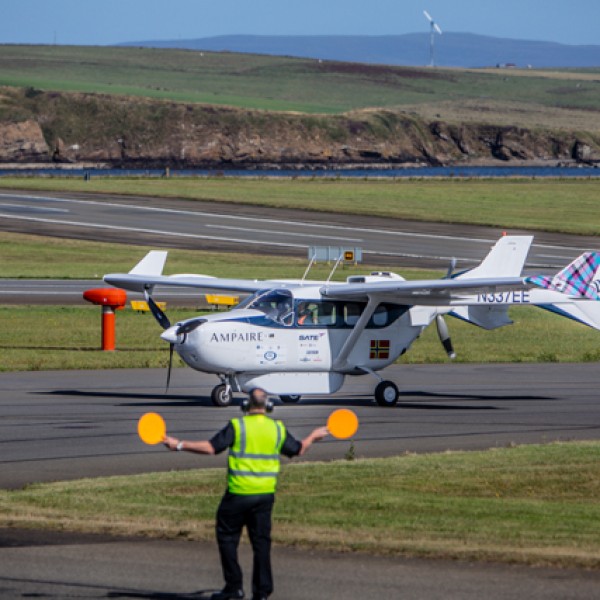
- August 2021: Ampaire demonstrates first hybrid electric aircraft in Scotland
- January 2021: Orkney to become Sustainable Aviation Test Environment
Funder:
The project was awarded £3.7 million from UK Research and Innovation (UKRI) through the Industrial Strategy Challenge Fund as part of the Future Flight Challenge

- HIAL, Arcadis Consulting Limited, Connected Places Catapult, Cranfield Aerospace Solutions, EMEC, Flare Bright Ltd, HITRANS, Loganair, University of Highlands and Islands (UHI), Windracers Limited, Highlands & Islands Enterprise (HIE), Orkney Islands Council, Hybrid Air Vehicles, Loganair, Cormorant Seaplanes, ARC Aerosystems