Islander
Quick facts:
Project: ISLANDER
Funder: Horizon 2020
Funding: € 7,000,000
Project timeline: 2020 – 2025
Partners: The ISLANDER consortium consisted of 11 organisations from 7 European countries committed to the community led energy transition of EU islands. 7 EU countries were represented by 11 organisations spanning research centres, SMEs, and large enterprises. For more information on the project partners, click here.
Project website: islander-project.eu
Project Overview:
The ISLANDER project set out to accelerate the decarbonisation of European island energy systems and strengthen their energy independence. Its core approach was to demonstrate smart grid solutions that integrate renewable energy generation with advanced storage technologies in real-world conditions.
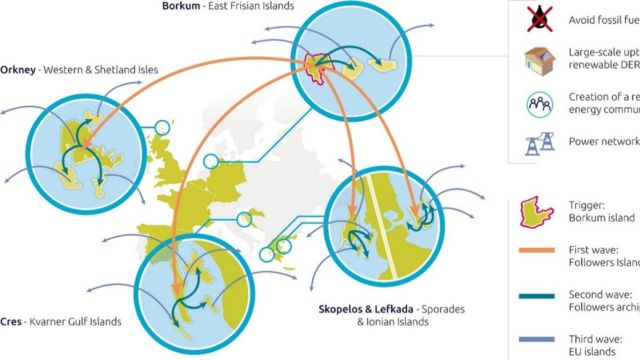
The flagship pilot took place on the island of Borkum, Germany, where a suite of innovative and scalable energy solutions was deployed. These installations served as a blueprint for adapting and replicating similar systems across other European islands. To support this ambition, the consortium included organisations representing four “follower islands”: Lefkada and Skopelos (Greece), Orkney (UK), and Cres (Croatia).
EMEC’s role:
EMEC led the replication activities for Orkney, one of the project’s follower islands. This work built on insights from the Borkum demonstration while leveraging Orkney’s extensive experience in hydrogen projects to support both Borkum and the other follower islands.
Replication followed a three-step approach:
- Follower islands – applying lessons from Borkum to Orkney, Lefkada, Skopelos, and Cres.
- Related archipelagos – extending replication to nearby archipeligos. In Orkney’s case, this was to Shetland and the Outer Hebrides
-
Inform strategies for wider European adoption.
Project outcomes:
The ISLANDER project focused on developing and implementing a smart energy management system capable of aggregating and optimising distributed energy resources alongside hybrid energy storage systems. All technology deployments were concentrated on Borkum Island, Germany, creating a real-world model for sustainable island energy systems.
Key Accomplishments
- Smart Energy Management – Developed a Smart IT platform to optimise distributed energy resources and hybrid storage, improving efficiency and grid stability. A mobile app enabled citizens to participate in the decarbonisation process.
- Renewable Energy Integration – Installed decentralised solar PV systems with energy storage in 30 households and three public buildings, complemented by a marine thermal district heating network.
- Innovative Storage Solutions – Introduced hybrid storage technologies, including hydrogen storage, lithium-ion batteries, and ultracapacitors.
- Electromobility Integration – Deployed a vehicle-to-grid (V2G) charging station to support renewable integration and improve grid resilience.
- Citizen Engagement – Established the Borkum Energy Community, empowering residents to take an active role in the island’s energy transition.
EMEC produced replication studies for Orkney, Shetland, and the Outer Hebrides, mapping energy generation and demand to assess feasibility.
The replication plans provide:
- A detailed overview of island energy status and grid structure, energy mix, demand, consumption, and generation
- A potential roadmap for applying solutions trialled on Borkum
- Comprehensive mapping of demand/generation and existing infrastructure (e.g., seawater district heating, EV chargers)
Knowledge Exchange
EMEC hosted a hybrid workshop through the Islands Centre for Net Zero (ICNZ) knowledge exchange forum, bringing together stakeholders from Orkney, Shetland, and the Outer Hebrides. The session explored ISLANDER outcomes and their relevance for accelerating island decarbonisation across Scotland.
Lessons and impact:
ISLANDER has laid the foundations for replicating smart energy solutions across European islands, starting with four follower islands and expanding to neighbouring archipelagos. Replication plans were developed for each island, supported by close stakeholder engagement.
Through exploring the feasibility of replicating the different solutions on the follower islands, the project revealed how policy, regulatory, geographical, and behavioural factors can vary significantly between islands. These variations meant some technologies could not be scaled everywhere, for example, current UK grid regulations made certain Borkum solutions unsuitable. This highlights the need to tailor approaches to local contexts.
The replication studies EMEC produced for Orkney, Shetland, and the Outer Hebrides, provide valuable baseline data on each island for future decarbonisation projects. These will be advanced by the Islands Centre for Net Zero (ICNZ) as resources to guide ongoing energy transition efforts, as a resource for projects requiring detailed energy data and infrastructure insights
Beyond technology, ISLANDER sparked wider discussions at community level on microgeneration and energy resilience. Project lessons learned have been compiled into practical recommendations to support broader uptake and future market deployment of ISLANDER technologies.