IEA-OES publish findings from 10 years of International WaTERS
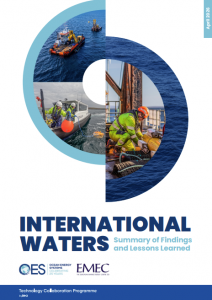
Commissioned by IEA-OES and prepared by EMEC, the publication highlights how test centres can accelerate ocean energy through collaboration, adaptive regulation and targeted investment
A new report published by the IEA-OES (International Energy Agency’s Ocean Energy Systems) Technology Collaboration Programme captures the key findings and lessons learned to date from International WaTERS, a network of wave and tidal energy research sites established and run by the European Marine Energy Centre (EMEC).
Commissioned by the IEA-OES Executive Committee, the report provides insights from over a decade of international collaboration between open-sea marine energy test centres.
International WaTERS was established by EMEC in 2013 to connect test centres, share experience and address common technical, regulatory, environmental and financial challenges. Drawing on workshops and exchanges held between 2013 and 2024 – bringing together delegates from across Europe, the Americas and Asia – the report provides a structured overview of the network’s evolution and lessons learned to inform future policy, investment and deployment.
The report notes that marine energy test centres have evolved from single-technology wave and tidal facilities into multi-technology innovation hubs, reflecting the sector’s response to growing technical complexity, market demand and policy priorities.
Adaptability, collaboration and evidence-based planning are highlighted as essential for reducing risk and building investor and regulatory confidence in ocean energy. Test centres are shown to play a leading role in environmental monitoring, adaptive management and risk-based consenting, alongside advocating for open data sharing and standardised protocols to reduce regulatory friction. Early, transparent engagement with communities, fisheries and regulators is central to securing social licence and building long-term trust.
The report concludes that continued investment in shared infrastructure, knowledge exchange and coordinated action will be critical to advancing marine energy towards commercial maturity and delivering economic, environmental and social benefits worldwide.
Matthijs Soede, Chairman of IEA-OES, said:
“As IEA-OES we are very happy with the global collaboration between test centres. Test centres are providing important (research) infrastructure for developers, and these developers can benefit from the knowledge and experience which they have built up over the years.
“International WaTERS is focused on turning shared experience into practical guidance that helps countries and stakeholders accelerate learning and lower barriers for ocean energy.”
Dernis Mediavilla, Head of Innovation at EMEC, said:
“International WaTERS exists to ensure that test centres are not solving the same problems in isolation. This report brings together what the network has learned – and where collaboration can make the biggest difference.”
Prepared to support future planning and strategic investment, the report also provides a foundation for evidence-based policy recommendations. These aim to advance regulatory frameworks, streamline consenting processes, strengthen stakeholder engagement, improve offshore operations and promote data sharing.
By capturing the collective experience of test centres and their partners, this report seeks to reinforce international collaboration and accelerate the development of sustainable ocean energy technologies.
The report is available to download here: International WaTERS: Summary of Findings and Lessons Learned