Can we design just energy transitions? Energy justice, innovation and the Orkney Islands
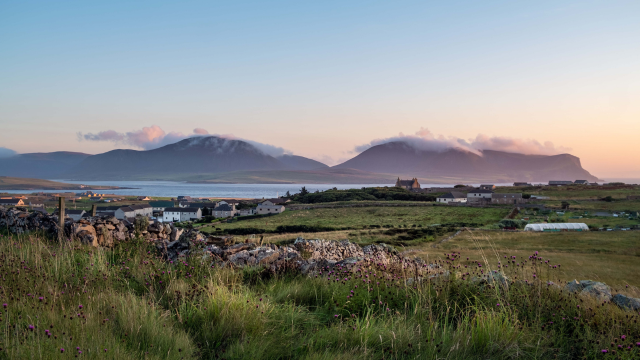
Stromness and Hoy, Orkney Islands(credit Alyona Naberezhnykh)
In this blog series, EMEC associate and researcher Dr. Lara Santos Ayllón shares insights from her PhD exploring energy justice, marine energy, green hydrogen and emerging energy futures in Orkney.
Drawing on research supported by EMEC, the University of Edinburgh, Heriot-Watt University and the Energy Technology Partnership, Lara examines whether it is possible to design fairer and more sustainable energy systems in the context of renewable energy innovation.
In this first blog, Lara introduces the concept of energy justice and the questions and experiences that inspired her research.
Climate change is driving an energy transition away from fossil fuels and towards renewable energy. While the transition to renewable energy is necessary, many scholars, activists and civil society have demonstrated that renewable energy will not automatically deliver better outcomes but instead, can result in social and environmental harm. This is because our energy systems and the climate crisis are not just biological, climatic or engineering challenges – they are also a question of ethics. This includes considering who benefits, who carries risk, who has a say, and who may be silenced or disadvantaged by different energy systems – across people and nature, and across geographies and generations. These dimensions make energy a question of justice, not just engineering.
‘Justice’ in an energy context can refer to:
- the harms and benefits of energy systems and how these are spread (distributional justice);
- the ways in which energy decisions are made, inclusion and exclusion dynamics, transparency, participation, power and influence (procedural justice);
- the recognition of human dignity, acknowledging the worth of diverse realities and experiences while aiming to end disrespect, invisibility and stigma. It considers whether these perspectives are misrepresented or silenced in the development of energy systems. One example is through use of the Not-In-My-Backyard, or ‘NIMBY’ term (recognition justice).
Fossil fuelled systems are both deeply unequal and socially and ecologically unsustainable. Moving to renewable energy does not automatically correct this; without care, it can uphold the same injustices in new forms. Because many low-carbon energy technologies and the systems they will operate in are still being developed, the transition also creates an opportunity to do things differently. It is a chance to actively design energy systems that support more sustainable and just outcomes. In Scotland, this ambition is often discussed through the lens of a “just transition”, with government commitments to embed justice in climate policy. But what this means in practice, particularly in places like Orkney, remains an open question.
In 2020, I moved to Orkney to work for the European Marine Energy Centre (EMEC). The islands are renowned worldwide for the adoption of renewable energy and energy innovation. EMEC is the world-leading test and demonstration centre for wave and tidal energy technologies and has also delivered world-first green hydrogen projects. Towed to the islands, connected to salty subsea cables, floating amidst traditional fishing grounds and stored within farm-like buildings, wave energy, tidal energy and green hydrogen technologies are projected to have global impact, while also influencing Orkney’s local futures. Like the technologies being tested and demonstrated here, Orkney’s own energy future is still being shaped.
My role at EMEC focused on gaining political support for EMEC, marine energy and low carbon innovation, along with coordinating outreach opportunities with local communities. I became increasingly interested in what, how and why energy technologies and systems were being designed. My connection to Orkney grew, as did my knowledge of the challenges and opportunities facing the islands through the energy transition. Although I found myself, and others, continuously promoting Orkney as a key site of renewable energy adoption and innovation, there was also less discussion about what a ‘just energy transition’ might mean for the islands in practice.
Both energy innovation and Orkney’s energy transition offered an opportunity to study the potential for (in)justice, to anticipate risks and opportunities and build these into the design of energy technologies, energy systems and ultimately, into our futures. Identified as clear gaps in both research and practice at the time, I received support and funding to explore these issues in a PhD.
I developed ‘Justice by Design’, a new methodology which integrates ‘energy justice’ and ‘Responsible Research and Innovation’ models, to engage with energy and justice issues in anticipatory, future-facing ways. The research drew on interviews and workshops involving people from industry, policy, academia, the third sector and communities across Orkney.
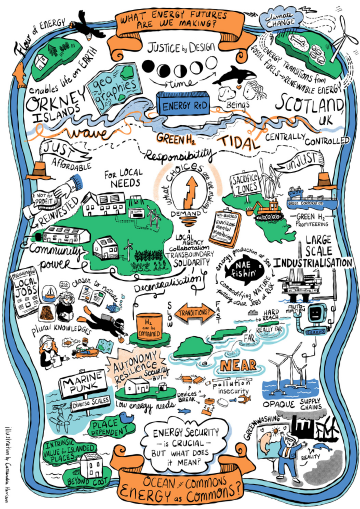
Visual Summary of Lara Santos Ayllon’s doctoral research (Credit Illustration by Cassandra Harrison)
In the blogs that follow, I’ll share findings on the anticipated justice risks and opportunities of marine energy and green hydrogen production, while exploring the justice dimensions of Orkney’s potential energy futures. These insights are relevant for policymakers, developers and communities seeking to design and deliver fairer, more sustainable energy systems.

Dr Lara Santos Ayllón
Researcher and EMEC Associate
About the research
This PhD research was funded through the Energy Technology Partnership (ETP) in collaboration with EMEC and the University of Edinburgh, and was supported by the International Centre for Island Technology, Heriot-Watt University in the Orkney Islands.
Read Lara’s full thesis: Santos Ayllón, L. M., (2025) ‘Making just futures: Anticipating energy (in)justices of energy innovations and place-based transitions. Wave energy, tidal energy, green hydrogen production and the Orkney Islands,’ University of Edinburgh
Further reading:
• Energy justice: A conceptual review (Jenkins et al., 2016)
• Scotland’s Climate Change Plan: 2026–2040
• Justice by Design: Integrating energy justice and responsible research and innovation (RRI) to deliver just energy futures (Santos Ayllón, L. M. et al, 2025)